We offer a wide range of services for that fresh look, or just maintenance or updates to keep your home functioning and safe. Regardless of the size of the job, we have a craftsman that can tackle it. We offer a wide range of services for that fresh look, or just maintenance or updates to keep your home functioning and safe. Regardless of the size of the job, we have a craftsman that can tackle it.
Home Improvement / May 18, 2026
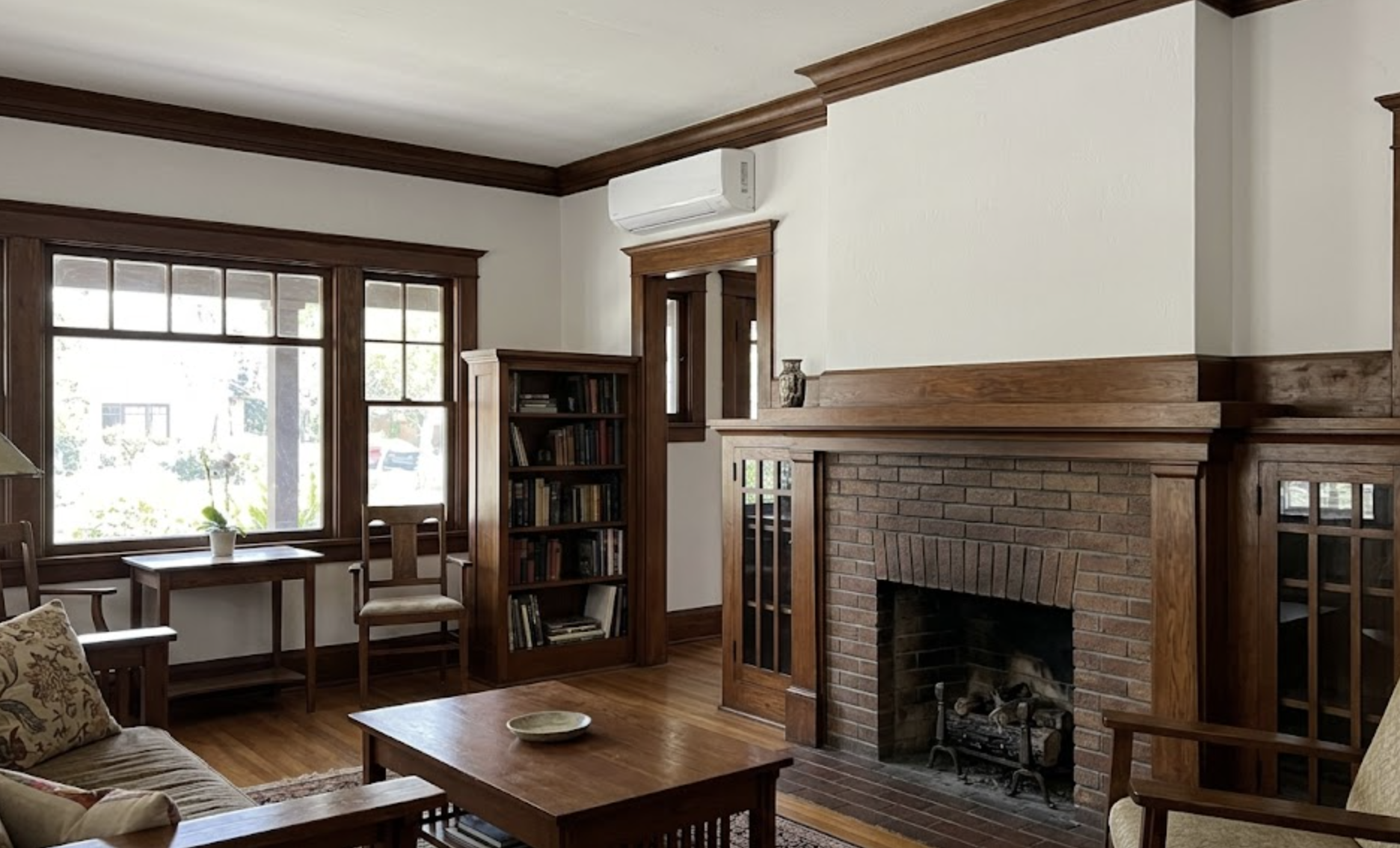
When the first triple-digit forecast lights up the San Gabriel Valley, Pasadena homeowners learn the same lesson their grandparents did: a 1920s Craftsman bungalow was never designed for a 2026 heat dome. Original wall thicknesses, no ductwork, knob-and-tube remnants behind the plaster, and an attic that radiates like a pizza stone all conspire to make traditional central air a five-figure nightmare. That is exactly why mini-split installation Pasadena has quietly become the most-requested cooling upgrade across our service area in 2026 — from Bungalow Heaven and Madison Heights to the foothill streets of Altadena and La Cañada Flintridge.
This guide walks you through everything you need to know before scheduling a mini-split installation Pasadena visit this pre-summer: how ductless systems actually work, what they cost in 2026, which neighborhoods and home styles benefit most, the permit and electrical realities of older San Gabriel Valley housing stock, and how to choose the right zoning configuration for your Craftsman, Spanish Revival, or mid-century home. Our craftsmen at Handyman Connection of Pasadena have been retrofitting cooling into historic homes from the Rose Bowl to South Lake Avenue for years, and the patterns we see every May are remarkably consistent.
The San Gabriel Valley climate is shifting faster than the housing stock. NWS data from the past five summers shows Pasadena routinely crossing 100°F on more than a dozen afternoons each year, with overnight lows that no longer drop into the comfortable 60s the way they did a decade ago. Meanwhile, more than 60% of single-family homes in the 91101–91107 ZIP codes were built before 1950 — which means they have plaster walls, no return ducts, and electrical panels never engineered for whole-house air conditioning.
For decades, homeowners in Bungalow Heaven, Madison Heights, the Arroyo Seco corridor, and the older streets of South Pasadena, San Marino, and Sierra Madre defaulted to noisy window shakers. They block historic wood-sash windows, drip onto wood sills, leak air around the sash, and chew through electricity. Ductless systems eliminate every one of those problems while delivering modern inverter-grade efficiency. That is why our phones light up the week after Pasadena’s first 95°F afternoon, and why mini-split installation Pasadena appointments fill up by late May every year.
Three things converged this spring: Southern California Edison and Pasadena Water & Power are both running heat-pump rebate programs, federal 25C tax credits remain available for qualifying high-efficiency systems, and inverter mini-split technology has reached a level of quietness and reliability that simply did not exist five years ago. Add to that the post-Eaton-Fire air-quality reality — better filtration matters when foothill smoke drifts into Altadena and Eagle Rock — and the case for ductless cooling has never been stronger.
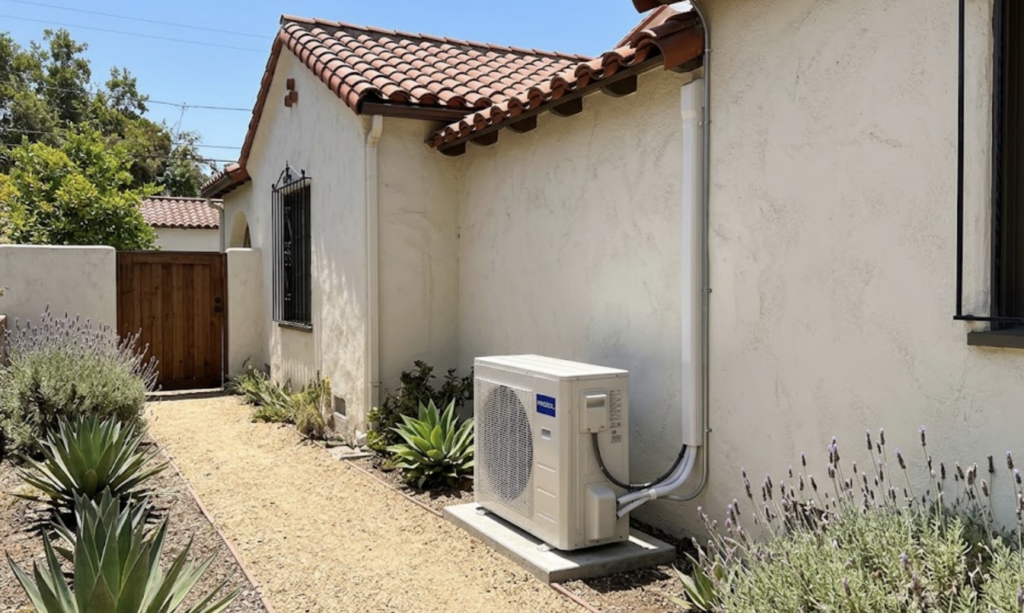
A mini-split is essentially a heat pump split into two parts. A small outdoor condenser sits along a side yard or alleyway. From there, a slim line set — refrigerant lines, a condensate drain, and low-voltage control wiring — runs through a 3-inch wall penetration to one or more indoor “heads.” Each head can be a wall-mounted unit, a ceiling cassette, a slim ducted air handler tucked into a closet, or a floor-mount console that hides behind a Craftsman bench. Each head is its own zone with its own thermostat.
Unlike old single-stage compressors that slam on and off, modern inverter mini-splits ramp the compressor up and down in tiny increments. The result: rooms hold within 1°F of setpoint, the system whispers at 19–22 decibels (quieter than a refrigerator), and energy bills drop dramatically. For a Pasadena homeowner used to a window unit, the first August power bill after a ductless conversion is usually the moment they wish they had done this years earlier.
Every modern mini-split is also a heat pump. That matters for Pasadena, Altadena, and La Cañada Flintridge homes that have been limping along with 50-year-old wall furnaces or noisy gas floor heaters. One install replaces two systems, and the same equipment that cools you in July keeps your guest room warm during a 38°F January morning in the foothills.
Ready for a no-pressure walkthrough of your home? Our team can scope a zoning plan in under an hour. Request a free in-home estimate and we’ll bring the load calculator, infrared thermometer, and a few real-world install photos from your neighborhood.
These are the textbook candidates. Plaster walls, original double-hung windows, and no chase space for ductwork mean that punching ducts through ceilings would destroy the very character these homes are protected for. A 2- or 3-zone mini-split lets us condition the living room, primary bedroom, and a converted attic office without touching a single original ceiling. We’ve completed dozens of these in Pasadena, South Pasadena, and along the leafy streets of Sierra Madre and Monrovia, and the pattern is always the same: invisible from the street, transformative inside.
The thick stucco and clay-tile roofs that make San Marino, Arcadia, and the Orange Grove Boulevard corridor so striking also trap heat after sundown. Mini-splits handle these homes beautifully because the line sets snake through stucco walls without disrupting the original arched plaster interiors. For homeowners in Temple City and Highland Park dealing with similar 1920s Spanish bungalows, the approach is essentially identical.
Many post-war ranches in Altadena and Eagle Rock have rudimentary central systems with crushed ducting in tight crawl spaces. Rather than rebuilding the entire duct network, a 4- or 5-zone ductless system often costs less, runs quieter, and produces a more even temperature room-to-room. For deeper remodel scenarios — like full kitchen or bath renovations — our colleagues at Pasadena Remodeler often coordinate the mechanical layout alongside the remodel timeline.
Pricing in the San Gabriel Valley has stabilized after the 2023–2024 refrigerant-transition spikes. Here is what we’re seeing on actual installed quotes across Pasadena, Altadena, South Pasadena, Arcadia, San Marino, Sierra Madre, La Cañada Flintridge, Eagle Rock, Highland Park, Monrovia, and Temple City as of pre-summer 2026.
These are real, code-compliant, permitted numbers — not the bait pricing you see on national big-box ads. Ductless mini-split cost Pasadena ranges vary mostly with electrical-panel work, line-set length, and whether condensate has to be pumped uphill (common in Sierra Madre and the steeper foothill streets of La Cañada Flintridge).
Three variables move the needle most: panel capacity (older 100-amp services in Bungalow Heaven often need an upgrade or sub-panel), the number of stories the line set has to travel, and whether you choose recessed ceiling cassettes (premium) or wall-mounted heads (value). Pasadena’s permit and inspection fees add roughly $350–$650 depending on jurisdiction; Arcadia and Monrovia tend to run slightly lower, La Cañada Flintridge and San Marino slightly higher.
The phrase heat pump installation San Gabriel Valley is showing up in search far more than it did even a year ago, and for good reason. California’s electrification incentives, combined with PWP’s TOU rate structure and the disappearance of natural-gas hookups in new construction, mean a single heat-pump mini-split now does the job of an old wall furnace plus a window AC plus space heaters. Homeowners in Eagle Rock and Highland Park converting historic duplexes have been particularly aggressive on this front because they can zone each unit independently.
As of May 2026, qualifying heat-pump mini-splits can stack the federal 25C tax credit (up to $2,000), PWP’s residential heat-pump rebate, and SCE rebates for households outside PWP territory. We always pull the current rebate sheets before quoting because they shift quarterly — but it’s not uncommon for a Pasadena homeowner to net $2,500–$4,500 off the install price once everything posts. For deeper context on long-term ROI of these systems within larger renovation projects, the team at Pasadena Remodel tracks how mechanical upgrades fold into kitchen, bath, and ADU additions across the Valley.
Ductless AC for older homes isn’t a magic wand. There are legitimate considerations every Pasadena homeowner should weigh before signing a contract.
A single 18,000 BTU outdoor unit typically needs a dedicated 220V/20-amp circuit. Most 1920s Pasadena homes still operate on 100-amp service — and if you’ve already added an EV charger, tankless water heater, or induction range, you may be at panel capacity. We coordinate panel upgrades, sub-panels, and load calculations as part of the mini-split scope so there are no surprise change orders.
Bungalow Heaven, the Arroyo Seco district, and several South Pasadena and San Marino historic overlays have rules about visible mechanical equipment. We route line sets through soffits, side-yard chases, and behind crown molding so nothing is visible from the street. Wall-mounted heads can be painted to match plaster, and slim ducted air handlers can be hidden entirely above closets — invisible from inside the room.
Pasadena requires a mechanical permit and an electrical permit for every install. Skipping the permit may save a homeowner $400 up front, but it creates a disclosure problem at resale and voids most manufacturer warranties. Every mini-split installation Pasadena project our craftsmen complete is permitted, inspected, and registered with the manufacturer for the full 10- or 12-year compressor warranty.
A rough rule we use across the San Gabriel Valley: one zone per “living area” plus one zone per bedroom you actually sleep in. A 1,400 sq ft Craftsman in Bungalow Heaven typically lands at 2 zones (open living/dining + primary bedroom). A 2,200 sq ft Spanish Revival in San Marino or Arcadia usually wants 3–4 zones. A 3,200 sq ft Monrovia or La Cañada Flintridge home often goes 4–5 zones with a slim-ducted handler hidden above the hallway to feed the kids’ bedrooms.
Oversizing is the #1 mistake we see on competitor quotes. An oversized mini-split short-cycles, fails to dehumidify, and wastes electricity. We run a room-by-room Manual J on every Pasadena, Altadena, and Sierra Madre install — measuring window orientation, attic insulation, and infiltration — before recommending capacity. A correctly sized 12,000 BTU head will outperform an oversized 18,000 BTU unit every single day of a Pasadena summer.
For homes that already have functional ductwork, a high-efficiency central heat pump can still be the right call. But for any Pasadena home where adding ducts means tearing into plaster, lath, or finished ceilings, ductless wins on cost, time, and preservation. Whole-house cooling Pasadena projects in older neighborhoods routinely come in 25–40% cheaper than the equivalent ducted central system — and they leave the home’s historic character intact.
Not sure which path is right for your home? Our craftsmen pre-summer schedule fills up by Memorial Day every year. Lock in your free estimate now and we’ll walk every room with you, run the load calc on the spot, and give you transparent pricing the same day.
Properly maintained mini-splits last 18–25 years in the San Gabriel Valley climate, which is genuinely longer than most central systems in the same neighborhoods. Maintenance is light: wash the head filters monthly during heavy use, have the line set and condensate professionally cleaned annually, and keep the outdoor condenser clear of jacaranda blossoms, sycamore leaves, and Eaton Canyon dust. Homeowners closer to wildfire-prone foothills in Altadena and La Cañada Flintridge should add a smoke-rated filter upgrade to the indoor heads.
The single most common feedback after one year: “I had no idea my house could feel like this.” The second most common: “My power bill is genuinely lower than the window units were costing me.” For deeper before-and-after stories and recent project photography across Pasadena, South Pasadena, Sierra Madre, and Altadena, browse our full handyman services portfolio or our partner content at Pasadena Remodeler.
A single-zone install is usually 1 day. Two- and three-zone systems run 2–3 days. Whole-house 4–5 zone installs in larger Arcadia, San Marino, or La Cañada Flintridge homes typically take 4–5 days including permit inspection.
Yes. Modern inverter mini-splits maintain rated cooling capacity up to 115°F ambient. We routinely see them outperform old central systems on the hottest July afternoons along the 210 Freeway corridor.
Absolutely. In fact, ductless systems are the preferred solution for Bungalow Heaven, Madison Heights, and the South Pasadena and San Marino historic districts precisely because they require only small wall penetrations and leave the home’s original character untouched.
Yes. PWP and SCE both offer heat-pump rebates as of 2026, and federal 25C tax credits cover up to $2,000 on qualifying high-efficiency systems. Eligible Pasadena, Altadena, Arcadia, Temple City, Monrovia, Sierra Madre, and South Pasadena homeowners can often stack incentives to offset $2,500–$4,500 of the install cost.
Portable units lose roughly 50% of their cooling capacity to exhaust-hose heat reintroduction, draw 1,400+ watts continuously, and never dehumidify well. A properly sized mini-split delivers 3–4 times the cooling per watt, runs near-silent, and lasts 5–10 times longer.
Every May, the same conversation repeats itself across Pasadena, Altadena, South Pasadena, Arcadia, San Marino, Sierra Madre, La Cañada Flintridge, Eagle Rock, Highland Park, Monrovia, and Temple City: “We’ve been talking about cooling for three summers — let’s finally do it.” The homeowners who win every year are the ones who schedule the assessment before the first heatwave. Once the temperatures spike, equipment lead times stretch from two weeks to six.
Our licensed and insured craftsmen handle the entire scope under one roof: load calculation, equipment selection, electrical work, mounting, line-set routing, condensate management, permit, inspection coordination, and rebate paperwork. No subcontractor handoffs, no surprise change orders, no historic-district drama. Just a cooler, quieter, more efficient home before the Rose Bowl’s first 95°F game-day Saturday.
Ready to get a real number on your home? Call (626) 744-0402 or request your free in-home estimate online. We serve every neighborhood from Old Town Pasadena to the foothills of La Cañada Flintridge — and we’d love to show you what your Craftsman, Spanish Revival, or mid-century home is actually capable of feeling like.

110 S Rosemead Blvd Suite G
Pasadena, CA 91107
License #992200

© Handyman Connection 2026 | Privacy Policy

 (626) 744-0402